Letters From Prison


2 Timothy 3:16–17 teaches that Scripture is God-breathed and useful for teaching, rebuking, correcting, and training in righteousness so the man of God may be equipped for every good work.
Highlights from this book.
Open the Bible tray, tap a verse number, then choose Highlight.
Choose a version, book, and chapter. The full Bible reader opens separately so the devotional stays focused.
Tap another verse number in this chapter to select a range.
Saving a note also keeps this scripture highlighted as one note, even when multiple verses are selected.
God's interruptions are often His assignments.
Before the broken leg, before the comeback, and before the public profession of faith, Conor McGregor had built an identity around dominance, fame, money, and becoming “the man.” His confidence made him one of the most recognizable athletes in the world, but it also frequently crossed into arrogance. At times, he openly mocked Jesus Christ and treated faith as something beneath him.
Then, on July 10, 2021, everything changed.
During the first round of his trilogy fight with Dustin Poirier at UFC 264, McGregor planted his left foot and suffered a catastrophic break of his tibia and fibula. He had entered the fight trying to reclaim his place at the top of the UFC. Instead, the fight ended with him seated against the cage, unable to stand, while years of plans suddenly became uncertain.
The injury did not create a brief delay. It began a five-year road back.
By the time McGregor prepared to return, the words coming from him sounded different. In interviews, he began speaking openly about the Gospel, identifying Jesus Christ as Lord and explaining that his strength came from God. He also admitted that his most difficult battle might not happen inside the cage. It might come afterward, when the attention, celebration, alcohol, and old temptations returned.
That admission matters. It is one thing to talk about trusting God when the cameras are on and the comeback is still ahead. It is another thing to recognize that victory itself can become a temptation. McGregor seemed to understand that reclaiming his old position could also invite him back into his old life.
On July 11, 2026, he finally returned to the Octagon at UFC 329 for a second fight with Max Holloway.
The comeback lasted sixty-nine seconds.
McGregor suffered another major knee injury, tearing his ACL and damaging his meniscus. Years earlier, he had injured his other knee while fighting Holloway and still managed to finish and win. This time was different. The damage came almost immediately. He could no longer defend himself, and the fight was stopped before the return had truly begun.
Once again, the plan collapsed.
But his response afterward revealed something worth considering. Rather than only expressing anger or self-pity, McGregor thanked the Lord for another chance at life and reflected on what God might still be teaching him. He even suggested that the injury may have protected him from falling into sin later that night—from stepping back into the role of “the man,” celebrating recklessly, and returning to the very patterns he had said he wanted to resist.
The story closes with McGregor echoing the words of Galatians 2:20: I no longer live, but Christ lives in me.
None of us can judge the condition of another man’s heart. Public words must be followed by lasting fruit. McGregor is not the hero of this chapter, and his story is not the standard of our faith. But his response raises an important question:
What happens when God interrupts the very plan we believed would restore us?
A man can spend years preparing for his return. He can finally reach the moment he has prayed and worked toward. Then, in sixty-nine seconds, the entire plan can disappear again.
Is that interruption proof that God has abandoned the story?
Or could the interruption itself become part of the work God is doing in the man?
That is where Paul meets us in Philippians. Paul had plans, purpose, freedom, and a mission. Then imprisonment changed nearly everything about his circumstances. Yet from his chains, he wrote:nn“What has happened to me has actually served to advance the gospel.”nnPaul’s plan was interrupted, but God’s purpose was not.
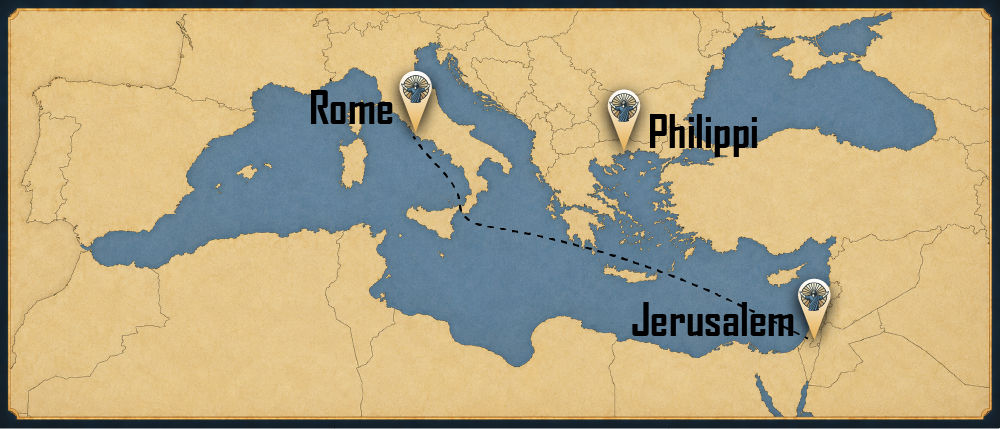
Philippians was written by the Apostle Paul while he was imprisoned under Roman authority, most likely during his first Roman imprisonment around AD 61-62. Some scholars have suggested Caesarea, and a smaller minority have proposed Ephesus, but Rome best fits the evidence within the letter and the chronology recorded in Acts. Paul refers to the praetorium, or imperial guard, in Philippians 1:13 and later sends greetings from believers connected to Caesar's household in Philippians 4:22. Together, these references strongly support a Roman setting. Paul's imprisonment followed several years of legal conflict and travel. He was arrested in Jerusalem around AD 57, transferred to Caesarea, and held there for approximately two years. After appealing his case to Caesar, he was sent toward Rome. The journey included violent storms, a shipwreck, and a winter on Malta before he arrived in Rome around AD 60. Acts 28:30-31 describes him living under house arrest for two years while awaiting trial. By the time Philippians was written, the church in Philippi had heard of Paul's imprisonment and sent Epaphroditus with financial support and practical care. Epaphroditus became seriously ill, recovered, and news of his illness traveled back to Philippi. These events required several long journeys and show that Paul had already been imprisoned for some time. Philippi was a Roman colony in Macedonia, located in modern-day northern Greece along the Via Egnatia, a major Roman road. The city had a strong Roman identity and included retired soldiers, Roman citizens, merchants, laborers, and enslaved people. Civic pride, Roman citizenship, and loyalty to Caesar shaped its public life. Paul first brought the Gospel to Philippi during his second missionary journey, as recorded in Acts 16. Lydia and her household believed, a slave girl was delivered from an evil spirit, and the Philippian jailer and his family were baptized. The church that grew from those events became one of Paul's closest and most faithful ministry partners. Paul wrote to thank the Philippians for their support, reassure them about his imprisonment, encourage unity, warn against pride and division, and call them to live faithfully as citizens of heaven within a deeply Roman culture. As he wrote, he knew his trial could result in either release or execution.
Philippians 1:12-18
Now I desire to have you know, brothers, that the things which happened to me have turned out rather to the progress of the Good News, so that it became evident to the whole palace guard, and to all the rest, that my bonds are in Christ, and that most of the brothers in the Lord, being confident through my bonds, are more abundantly bold to speak the word of God without fear. Some indeed preach Christ even out of envy and strife, and some also out of good will. The former insincerely preach Christ from selfish ambition, thinking that they add affliction to my chains; but the latter out of love, knowing that I am appointed for the defense of the Good News. What does it matter? Only that in every way, whether in pretense or in truth, Christ is proclaimed. I rejoice in this, yes, and will rejoice.
What is the headline or main thought of this passage in a nutshell?
Saved on this device.What thoughts, actions, motives, or patterns does this passage expose in me?
Saved on this device.What do I need to stop, start, or continue in light of God’s Word?
Saved on this device.How might God be preparing me for good works through this passage?
Saved on this device.
Paul wants the Philippians to understand that his imprisonment has not stopped the Gospel. It has advanced it. The word translated 'advance' carries the idea of moving forward through resistance, like someone cutting a path through difficult ground. What appeared to be a barrier became a pathway. Paul's chains gave him access to Roman guards who may never have heard the Gospel otherwise, and his courage inspired other believers to speak about Christ more boldly. Paul also acknowledges that not everyone preaching Christ has pure motives. Some preach from love and partnership. Others preach from envy, rivalry, or selfish ambition. Yet Paul refuses to make himself the center of the situation. His deepest concern is not his reputation, comfort, or personal success. His concern is that Christ is proclaimed. This reveals the heart of the passage: Paul measures his circumstances by the advance of the Gospel, not by the fulfillment of his personal plans. His imprisonment looked like a setback, but God used it as an assignment. His platform changed, but his purpose did not.
Every man carries a picture of how life is supposed to unfold. A career that progresses. A marriage that remains strong. Healthy children. Financial security. A respected name. A ministry or calling that develops according to plan. Then life interrupts us. A diagnosis. A layoff. A divorce. A prodigal child. A move we did not want. A broken relationship. A failed business. A dream that never materializes. A season that lasts much longer than expected. Our instinct is usually to ask, 'Why did this happen?' Paul teaches us to ask a better question: 'Lord, how do You want to use this?' That question does not minimize pain. It does not pretend every loss is easy or that every circumstance immediately makes sense. It simply recognizes that God's purpose is not canceled when our plans change. The interruption may expose something in us that needs to change. It may place us beside someone who needs to hear the Gospel. It may slow us down, redirect us, humble us, strengthen us, or prepare us for an assignment we never would have chosen. Very often, God's greatest work begins where our plans end. Faithfulness does not require us to understand the entire story. It requires us to obey God in the part of the story we are living right now.
For one week, stop asking, 'What is my purpose?' and begin asking, 'What needs to be done?' Serve one person without being asked. Encourage one brother with more than a quick text. Finish one responsibility you have been avoiding. Do not post about it or look for recognition. Be where your feet are, carry what God has placed in front of you, and load the wagon.
Father, thank You that Your purpose is never limited by my circumstances. Forgive me for measuring Your faithfulness by my comfort or by whether life follows my plans. Give me eyes to see opportunity where I currently see interruption. Help me trust You in the places I do not understand. Teach me to remain faithful in every season and use my home, work, struggles, relationships, and story to advance the Gospel. Show me the assignment within this interruption and give me the courage to obey. In Jesus' name, Amen.
Mark this chapter complete when you have read, reflected, prayed, and taken the next step God has placed in front of you.
Contentment is not found in your circumstances. It is found in Christ.
Tyson Fury spent his life chasing one thing.
Become heavyweight champion of the world.
On November 28, 2015, he did it.
Fury walked into Germany as the challenger and defeated Wladimir Klitschko, ending a championship reign that had lasted nearly a decade. He walked out holding the heavyweight titles.
The goal had been reached.
The belts were his.
Money. Fame. Recognition. Family. Success.
He had climbed the mountain.
And then something unexpected happened.
The top of the mountain was empty.
Fury has described what followed as an enormous emptiness. Within the next year, his life spiraled through severe depression, drinking, drug use, inactivity, and the loss of the very titles he had spent his life pursuing. He later described looking around at everything he possessed and realizing that having everything a man might dream of had not made him whole.
That is what makes his story so useful for us.
Most men believe discontentment is a problem caused by not having enough.
Not enough money.
Not enough success.
Not enough recognition.
Not enough progress.
Not enough house.
Not enough influence.
Not enough strength.
So we naturally assume the cure is more.
Fury got more.
He got nearly everything he had been chasing.
And the hunger remained.
Years later, while discussing what he had learned, Fury said something remarkably simple:
“When Christmas is every day it doesn’t make you happy.”
Eventually, Fury began rebuilding his life. He has spoken openly about prayer, faith in God, getting help, returning to training, and recognizing that he could not pull himself out of the darkness alone.
Fury is not the hero of this chapter.
And his life is not our theology.
But his story exposes something Scripture has been telling men for thousands of years:
Getting everything you want cannot give you what only God can provide.
That brings us back to another prisoner.
Paul.
Paul had experienced both sides.
He knew what it was like to have plenty.
He knew what it was like to have almost nothing.
And sitting in prison, he wrote that he had discovered a secret.
Not the secret to getting more.
The secret to finally having enough.
Philippians 4:10-13 comes near the end of Paul’s letter.
The church in Philippi had renewed its financial support of Paul by sending Epaphroditus with practical help and resources.
Paul was grateful.
That matters.
Christian contentment does not mean pretending money does not matter, food does not matter, circumstances do not matter, or help from other people does not matter.
Paul rejoiced over their generosity.
But then he immediately makes something clear:
His peace did not begin when the money arrived.
Paul tells them:
“I have learned in whatever situation I am to be content.”
That word matters.
Learned.
Paul was not naturally content.
Contentment had been trained into him.
His life had included both provision and poverty.
Success and rejection.
Friendship and abandonment.
Freedom and imprisonment.
Paul had experienced seasons when resources were available and seasons when he did not know where his next provision would come from.
Through all of it, he learned that circumstances constantly move.
Christ does not.
The Philippians’ gift changed Paul’s resources.
It did not change his source.
And that distinction becomes the foundation for everything he says next.
Philippians 4:10-13
But I rejoice in the Lord greatly, that now at length you have revived your thought for me; in which you did indeed take thought, but you lacked opportunity. Not that I speak because of lack, for I have learned in whatever state I am, to be content in it. I know how to be humbled, and I also know how to abound. In everything and in all things I have learned the secret both to be filled and to be hungry, both to abound and to be in need. I can do all things through Christ, who strengthens me.
What is the headline or main thought of this passage in a nutshell?
Saved on this device.What thoughts, actions, motives, or patterns does this passage expose in me?
Saved on this device.What do I need to stop, start, or continue in light of God’s Word?
Saved on this device.How might God be preparing me for good works through this passage?
Saved on this device.Philippians 4:13 may be one of the most quoted verses in Scripture.
“I can do all things through him who strengthens me.”
We put it in weight rooms.
On shirts.
Under sports highlights.
Before competitions.
I literally tattooed it on my body.
And there is nothing wrong with asking Christ for strength to compete, build, work, lead, endure, or accomplish difficult things.
But that is not primarily what Paul is talking about here.
Verse 13 is the conclusion to verses 11 and 12.
Paul says:
I know how to have little.
I know how to have plenty.
I know hunger.
I know abundance.
I know need.
I can face all of it because Christ strengthens me.
That changes the verse.
Paul is not promising:
Christ will give me the strength to achieve whatever outcome I choose.
Paul is declaring:
Whatever outcome comes, Christ will give me the strength to remain faithful.
And there is another part of this passage we often overlook.
Paul had to learn contentment in abundance too.
We understand why poverty would test a man.
But plenty tests us too.
Need whispers:
God has forgotten you.
Abundance whispers:
You do not need God anymore.
Both are lies.
Having more does not automatically produce contentment.
Often, more simply moves the line.
The raise becomes normal.
The new truck becomes old.
The bigger house creates another project.
The business hits one goal and immediately creates another.
The body reaches one milestone and discovers another flaw.
The recognition we wanted becomes the recognition we now expect.
That is why Fury’s story connects so naturally with this passage.
The heavyweight championship was not bad.
Winning was not bad.
Money was not bad.
Recognition was not bad.
The problem was expecting those things to carry a weight they were never designed to carry.
Paul had discovered something better.
He says:
I have learned the secret.
The secret is not poverty.
The secret is not wealth.
The secret is not lowering every goal until you stop caring.
The secret is Christ.
Contentment does not mean you stop building.
It means what you are building no longer has to save you.
A content man can work incredibly hard.
He can pursue excellence.
He can build a business.
Train his body.
Provide for his family.
Improve his home.
Set bigger goals.
Compete.
Win.
But the outcome no longer gets to tell him who he is.
He can pursue more without needing more to be okay.
That is freedom.Most men have an unfinished sentence running quietly underneath their lives:
I’ll finally be content when...
When I make more money.
When the debt is gone.
When we get the house.
When the business grows.
When I get promoted.
When the kids get older.
When my marriage gets easier.
When I get back in shape.
When people notice what I bring to the table.
When I finish this project.
When this season finally changes.
The thing at the end of that sentence is not necessarily bad.
The dangerous word is:
When.
Because “when” gives us permission to postpone living faithfully today.
I will be grateful when.
I will slow down when.
I will enjoy my family when.
I will give generously when.
I will have peace when.
I will serve when.
I will finally be okay when.
Then we reach the milestone.
And almost immediately the finish line moves.
That is the trap Fury’s story exposes so clearly.
We think contentment is waiting on the other side of achievement.
Sometimes achievement simply reveals that contentment was never there.
Then comparison makes the problem even worse.
Another man has more.
More money.
A better house.
A stronger marriage.
A bigger business.
A better physique.
More influence.
More opportunity.
Suddenly something you thanked God for yesterday feels inadequate today.
Nothing about your blessing changed.
You just changed what you were comparing it against.
Comparison can turn blessings into disappointments without changing the blessing at all.
Contentment breaks that cycle.
Contentment allows me to look at another man and say:
God has been good to him without believing God has therefore been bad to me.
Contentment lets me pursue something better while still thanking God for what is here.
Contentment lets me say:
I want this circumstance to change.
I am going to work toward changing it.
I am going to pray about changing it.
But I do not need it to change before I can trust Christ.
That man is difficult to enslave.
He can own things without things owning him.
He can work without worshiping work.
He can win without becoming proud.
He can lose without being destroyed.
He can celebrate another man without competing with him.
He can plan for tomorrow without refusing to live today.
Why?
Because his deepest need has already been met.
Christ is enough today.For one week, stop postponing contentment.
Every morning finish this sentence:
Christ is enough today even if...
Name one thing you want to change.
Then name three things God has already provided.
Before asking God for more, thank Him for what is already here.
And identify one man you have been tempted to compare yourself against.
Instead of competing with him in your mind, encourage him.
Tell him specifically where you see God’s grace in his life.
Comparison asks:
Why him?
Brotherhood says:
Good for him.
Practice becoming the second man.Finish these two sentences honestly:
I keep believing I will finally be content when...
Christ is enough today because...Father, forgive me for looking to achievement, money, possessions, recognition, comfort, or success to give me what only You can provide.
Forgive me for believing that more will finally make me enough.
Teach me the secret Paul learned.
Teach me to have little without believing You have forgotten me.
Teach me to have much without believing I no longer need You.
Give me strength to remain faithful in plenty and hunger, abundance and need.
Help me work hard without worshiping my work.
Help me pursue goals without allowing those goals to determine my worth.
Free me from comparison.
Teach me to celebrate what You are doing in another man’s life without questioning what You are doing in mine.
Thank You for what You have already placed in front of me.
Thank You that my peace does not have to wait for the next achievement.
Christ, teach me that You are enough today.
In Jesus’ name, Amen.Mark this chapter complete when you have read, reflected, prayed, and taken the next step God has placed in front of you.